Facebook Stories unlocks public sharing

Facebook Stories unlocks public sharing


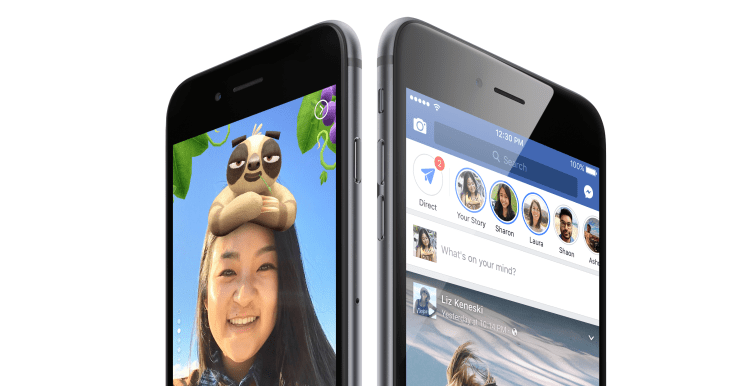
Facebook could jumpstart its Snapchat clone by letting social media stars and public figures post Stories publicly. When Facebook Stories launched globally in March, you could only share to all their friends or a subset of them. Now if you allow public followers, you can post your Story publicly so anyone can watch.
Social media researcher Carlos Gil first pointed out the privacy feature, and now a Facebook spokesperson confirms to TechCrunch that “This is something we rolled out a few weeks ago. The Public setting allows your Followers to see your story, in addition to your Friends.” As for if or when Pages will be able to post Stories, Facebook tells me “For Pages – no specific timing to share there quite yet.”

How to share Facebook Stories publicly
Public sharing gives Facebook Stories the potential to mint or popularize internet celebrities the same way Snapchat and Instagram Stories can. My initial experience with posting publicly saw over 1000 of my 60,000 followers watch my Facebook Story in 12 hours. That’s much more engagement than I get when I publicly share on the News Feed, indicating that Facebook might be prominently showing Stories from public figures in the horizontal scrolling section above the feed, or that most people just don’t have any friends posting Stories so anything that appears there stands out.
To make a Facebook Story public, first tap on the Add To Story button on the home screen, and post a photo or video. Then view your own Story and tap the three dots ‘more’ button in the top right. Open “Edit Story Settings” and change from “Friends” to “Public”. All your existing Facebook Stories from the last 24 hours plus any you share from then on will be publicly visible to anyone. You can tap on the viewer count to see the names of friends who’ve viewed your Story, and a count of all the additional followers who saw it without their names.
Facebook has proudly shared the rapid traction of Instagram Stories, both of which have over 250 million daily users. That makes them bigger than Snapchat, which has 166 million daily users for its whole app and has seen growth slow down since the Facebook-owned competitors launched. But Facebook hasn’t announced anything about Messenger Day or Facebook Stories usage, and many people say that few friends post on either. The fact that it took several weeks for people to spot the public sharing feature is a testament to its slow traction.
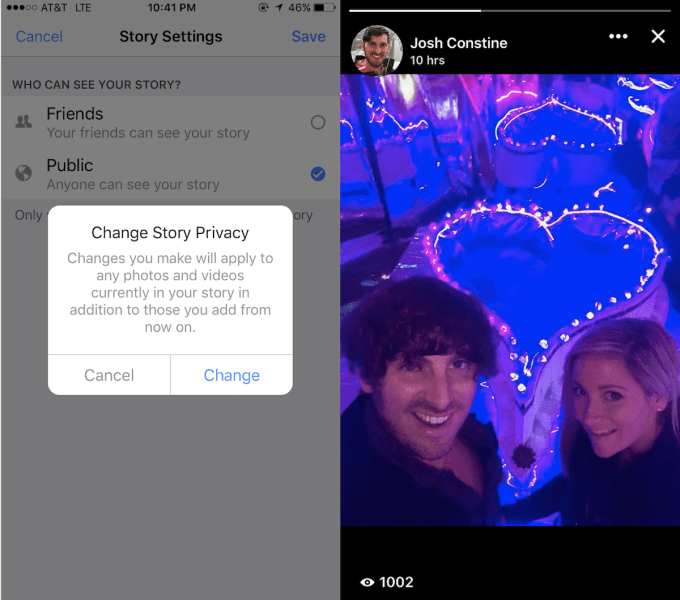
Changing your Facebook Stories privacy setting
While Instagram was built for visual sharing and WhatsApp Status is popular in developing countries where Snapchat isn’t, Stories feels a bit obtrusive on Messenger and redundant on Facebook. You already have so many other ways to share on Facebook, and if you care about sharing your day-to-day life, you’re probably already on Instagram Stories.
Here’s a quick breakdown of the privacy options available on different Stories products:
    • Snapchat Stories: Everyone, My Friends, Custom
    • Instagram Stories: Everyone for public accounts, approved followers for private accounts, plus hiding from specific people
    • WhatsApp Status: My Contacts, My Contacts Except…, Custom
    • Messenger Day: Everyone with permission to message you, Custom
  • Facebook Stories: Public, Friends, Custom
The addition of public Stories could open a whole different class of content creators to the photo/video slideshow format. Journalists who have big followings for their articles on Facebook could now use Stories for raw and immersive looks at the news, combining monologues, screenshots, and interviews.
If Facebook isn’t careful about how it ranks Stories from public figures and web celebs, these self-promoters could overrun Stories. But if it fills the often empty space with content, it could teach people to use Stories. That important to Facebook since it sees the feature is the home of its expanding augmented reality strategy.
Raspberry Pi: 14 million sold, 10 million made in the UK

Raspberry Pi: 14 million sold, 10 million made in the UK

raspberry-pi-3-b.jpg

Raspberry Pi's chief manufacturer, the Sony UK Technology Centre, has hit a pretty sizeable milestone.
Five years ago, Sony UK was approached to make 10,000 Raspberry Pi units per year -- that's a tiny 27 a day -- but today it churns out up to 15,000 a day and recently rolled the 10 millionth unit of Britain's best-selling computer off its production line.
To commemorate the milestone, Sony TEC UK has detailed key figures illustrating the remarkable growth of its contract manufacturing business since making its first Raspberry Pi in 2012.
Photos of the Raspberry Pi through the ages: From the prototype to Pi 3
A walkthrough of every model of the Raspberry Pi to be released dating back to an early prototype in 2006.
The 30,000 square metre Sony UK facility, based in Pencoed, South Wales, has scaled up so that its peak Raspberry Pi production capacity can reach 100,000 units per week.
The facility has made professional A/V Sony equipment for decades, but took on Raspberry Pi manufacturing for element14 in 2012, which has become a key part of its contract electronics manufacturing business.
Prior to this, the Raspberry Pi was made in China; some models are now also made in Japan.
"Our growth has been intrinsically linked to the success of the Raspberry Pi and we are delighted to reach the 10m manufacturing milestone," said Steve Dalton, Sony UK TEC's managing director.
Raspberry Pi founder Ebert Upton also announced that 14 million Raspberry Pi computers had been sold now. That's up from 12.5 million units over five years in March.


"We are particularly delighted that the Pi has set the benchmark for utilizing innovative and progressive manufacturing right here in the UK, as it was always our wish to make the computers in this country," said Upton.
THE BEST DRONE YOU CAN BUY RIGHT NOW (2017)

THE BEST DRONE YOU CAN BUY RIGHT NOW (2017)

To find the best drone for you, first you’ll need to figure out what it is you want out of a flying camera. Are you an action sports junkie trying to capture your sick moves for a highlight reel? An aspiring cinematographer aiming to up your production values? Or a social media star hoping to supercharge your selfie game? There are great drones across a wide range of sizes and prices, and the best match depends on your answer.
Okay, you say, but what if I’m not sure exactly what I want out of a drone? Well, if you are intrigued by the category and want to get a taste, we’ve picked the perfect starter drone, a unit that won’t break the bank, but can still deliver serious footage and range. Along with that, we’ve picked the best drone for amateur filmmakers and a unit that can satisfy all the needs of an outdoor athlete.
This article will be continually updated as new drones are released and reviewed, so be sure to check back if you’re not buying a drone right now.

THE BEST STARTER DRONE RIGHT NOW: DJI SPARK

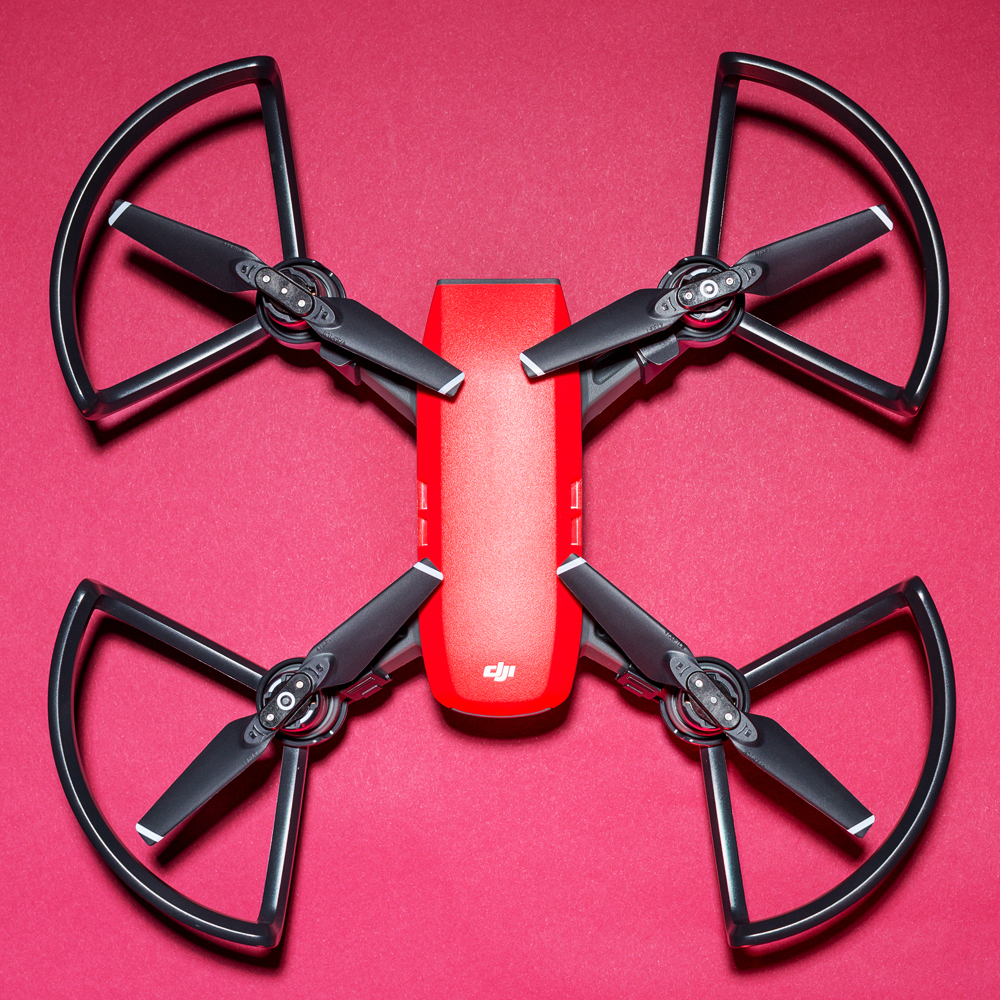
DJI Spark drone top down on red background

At $500 and 300 grams (less than the weight of three iPhone 7 phones), the Spark is DJI’s most approachable drone. You don’t have to learn how to fly a two-stick controller to get results. You can launch and land it from the palm of your hand and use gestures to move it around and snap photos. With the tap of a button in the app, you can initiate more complex maneuvers for more dramatic shots or set the drone to follow a particular subject.
If you control the Spark with your gestures or a smartphone, the range is rather limited. But if you want to get more ambitious, DJI sells a remote control that will allow you more fine-grained control and over a mile of range and a top speed of just over 30 miles an hour in “sport mode.”
The camera only records in 1080p and is stabilized with a two-axis gimbal. But the results, when compared with most drones of this size and price, are spectacular. If your goal is to make great memories and have footage good enough to share on social media and YouTube, the Spark has you covered.

A SECOND OPTION: DJI MAVIC PRO

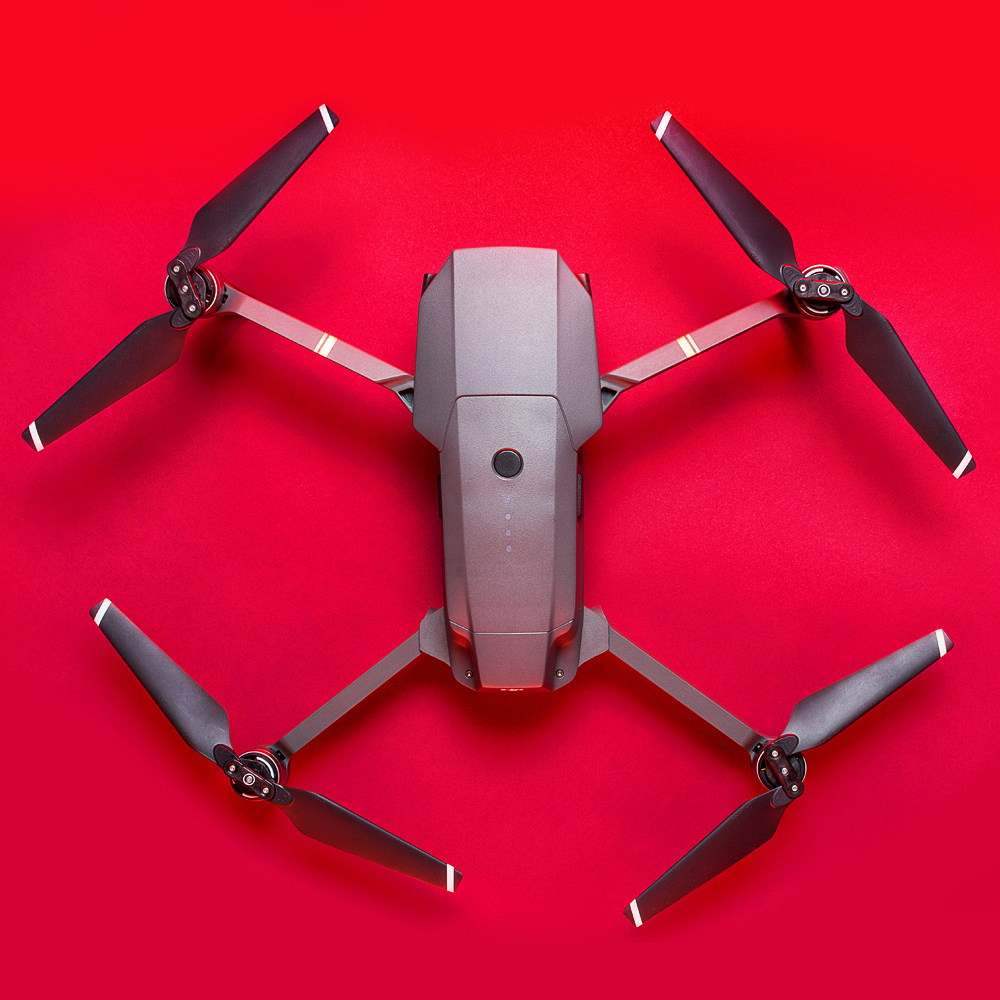
DJI Mavic Pro drone closed on red background

If you want a drone with a range and speed that goes well beyond the Spark, the next-best option is DJI’s Mavic Pro. Like the Spark, it’s quite portable. With its legs folded up, the Mavic fits easily into my messenger bag, and can even slip into a large jacket pocket. It has over 25 minutes of flight time on a single charge, a top speed of 40 miles and hour, and a range of over four miles when used with a remote. Importantly, it also has a larger camera with a three-axis gimbal, meaning your video footage is better stabilized, and can shoot in full 4K.
The trade-offs for this extra power and performance over the Spark come in the form of size, price, and complexity. The Mavic is portable, but definitely larger and heavier than the Spark. It’s also twice the cost, retailing for $999. Lastly, unless you’re a very confident expert, you need to have a flat surface to take off and land, not just the palm of your hand. And while you can use the Mavic indoors, it’s much bigger, louder, and more intimidating to bystanders than the Spark.

OTHER CONTENDERS

There are plenty of other drones on the market. Some might be better for you if you’ve already bought into the company’s ecosystem, or want more flexibility out of your camera gear. Others should be avoided at all costs.
7VERGE SCORE

GOOD STUFF

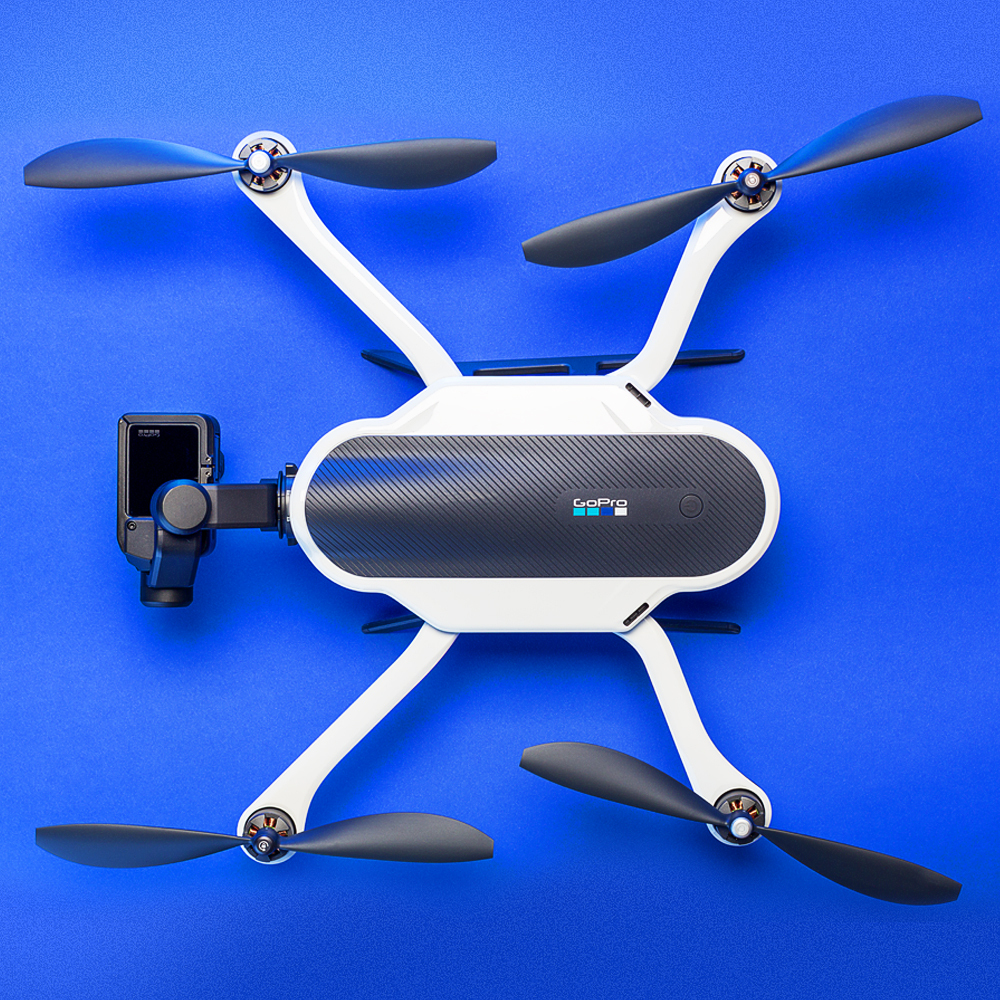
  • Detachable gimbal doubles as handheld stabilizer
  • Comes with shoulder harness for mounting camera on your body
  • Well priced if you already own a GoPro camera

BAD STUFF

  • Limited range
  • Can’t autonomously track subjects
  • Can’t sense and avoid obstacles
6.5VERGE SCORE

GOOD STUFF

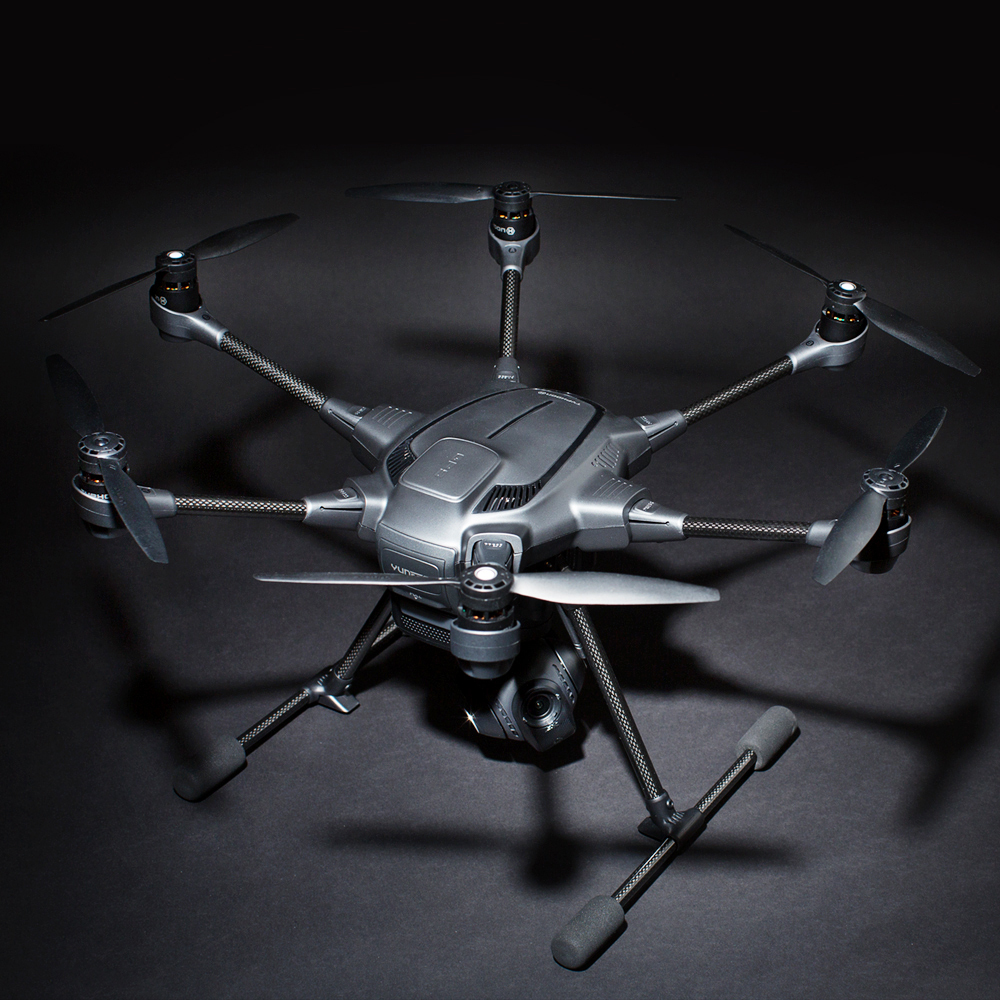
  • Stable in high winds
  • Can fly even after losing a rotor
  • Solid picture quality and stabilization

BAD STUFF

  • Very large and heavy
  • Poor build quality
  • Limited range
4.5VERGE SCORE

GOOD STUFF

  • Cheap
  • Lightweight

BAD STUFF

  • Shoddy connectivity
  • Poor image quality